The Illuminators Meetings at University Hospitals
(A Playbook for organizing your own similar sessions is also available behind the paywall for paid subscribers to this Substack.)
The day starts with a song. Van Morrison’s “Warm Love” plays as several dozen people from across University Hospitals sign in to our weekly Microsoft Teams call. It’s 8 a.m. Monday morning, and our playlist—built from participants’ suggestions—has grown to hundreds of songs. When the music fades, I welcome everyone and we begin, as we always do, with a well-being moment.
The Illuminators is a reader-supported publication. To receive new posts and support my work, consider becoming a free or paid subscriber.
This week, I invite people to think about the ripple effect of our everyday actions: a physician who sits down to talk with a patient instead of standing in the doorway, a teammate who notices someone is having a hard day, a mentor who takes an extra five minutes. These are what psychologist Barbara Fredrickson calls “micro-moments,” and they ripple out into the world. I invite people to think of someone whose ripples have reached them, and what ripple they want to make today.
From there, the hour moves between recognition, learning, and connection. We celebrate and recognize a hospitalist whose persistence after discharge may have prevented a patient with two mechanical heart valves from having a stroke. I confirm that we’ll send the hospitalist an Illuminators pin—our small but meaningful token of appreciation—so she knows that others see in her the qualities of an illuminator: humility, curiosity, compassion, respect, helpfulness, and accountability.
Teams from across the system share progress in patient experience, age-friendly care, blood utilization, workplace safety, and psychological safety. Some stories and presentations are polished successes, while others are still unfolding – proving there is something powerful in learning together along the way. Each story offers something to the group: a lesson, an idea, a person to call.
By the end of the hour, I feel what I have felt so many Mondays before: this is a place where people belong. We are a community of practice, learning with and from one another. Physicians, nurses, administrators, and functional staff are all welcome, all treated with equal regard. I am reminded that the Illuminators has become a space anchored in love and accountability.
Peter Pronovost, MD, Chief Quality & Clinical Transformation Officer, often says, “Healthcare doesn’t have a knowledge problem; it has a learning problem.” Illuminators is one of our most important learning communities at UH. It’s a space we intentionally protect, where judgment is replaced with curiosity and people are invited to share what they know, what they are trying, and what they are still learning.
When leaders from other organizations hear about the Illuminators meetings, they ask how they can create something similar. There is no exact formula, and their version should reflect their own people and culture. But our experience offers a useful story about how a recurring meeting can become a genuine learning community—and how, in creating space for other people’s voices, I began to find more of my own.
Origins of the Meetings
The Illuminators sessions started in 2018 as a weekly huddle of about 25 senior leaders who reported to Dr. Pronovost (Peter, as we all call him). We represented population health, utilization management, infection prevention, integrated care delivery, patient experience, digital outreach, palliative care, and other functions dedicated to improving the quality and effectiveness of our healthcare system.
Initially, the format was familiar: leaders reported their teams’ accomplishments. As in most corporate meetings, people were most comfortable speaking when they had positive results to share. The meetings provided useful updates, but they had not yet become a place for openness, connection, and shared learning.
That began to change in November 2020, when we held a four-hour virtual Clinical Transformation Retreat during the COVID-19 pandemic. After all we had experienced together, a stronger sense of community was beginning to emerge. As the retreat came to a close, I played “On Top of the World” by Imagine Dragons. I will always remember Ken Rosenthal, MD, who led palliative care for our system at the time, taking off his suit jacket and dancing on camera. Others joined in. It was joyful, unexpected, and it sent a powerful signal to everyone on the call: we can bring more of ourselves into this space.
That moment shifted something in me. I had once thought leadership presence meant having the strongest answer or being the most commanding person in the room. I began to understand that it could look different. As I looked at the leaders I most admired, I saw their influence came not only from their expertise, but also from the authenticity and compassion they brought to their roles.
After the retreat, we knew we had created something special. The meetings began evolving into what Peter described as a peer learning group, and we invited colleagues from other departments to join us. COVID had placed a significant financial burden on UH, and we began to see how our teams and other parts of UH were interconnected. We could not solve our challenges within departmental boundaries. We needed to learn from one another and work together.
We held another large retreat in November 2022, this time in person. It included others from across the UH System. We intentionally seated people from different departments together. Each table focused on a broad area for problem-solving: patient communication, patient education, technology, policies and metrics, collaboration, and staff empowerment. We asked each team to identify what UH should stop doing, start doing, and continue doing within each category.
The ideas generated in this session became the foundation for meaningful changes across UH. For example, participants recognized that we were sending patients too many digital announcements, creating confusion rather than clarity. By bringing different perspectives into the same conversation, we were able to see problems – and potential solutions – that might have remained hidden within individual departments.
By then, our Living and Leading with Love initiative was underway. We decided to redesign the weekly call around a more intentional approach to connection, learning, and culture. We borrowed the name Illuminators from New York Times columnist David Brooks. In his book How to Know a Person, Brooks distinguishes between people who illuminate the others around them (helping others feel seen, valued, and understood) and people who diminish them.
The Six R’s
“If you are a leader in the healthcare field,” Peter says, “you already know that beliefs are difficult to change. They reflect deeply held attitudes, based on factors that are obscure to us. We must therefore set up conditions in which people reconsider their beliefs.”
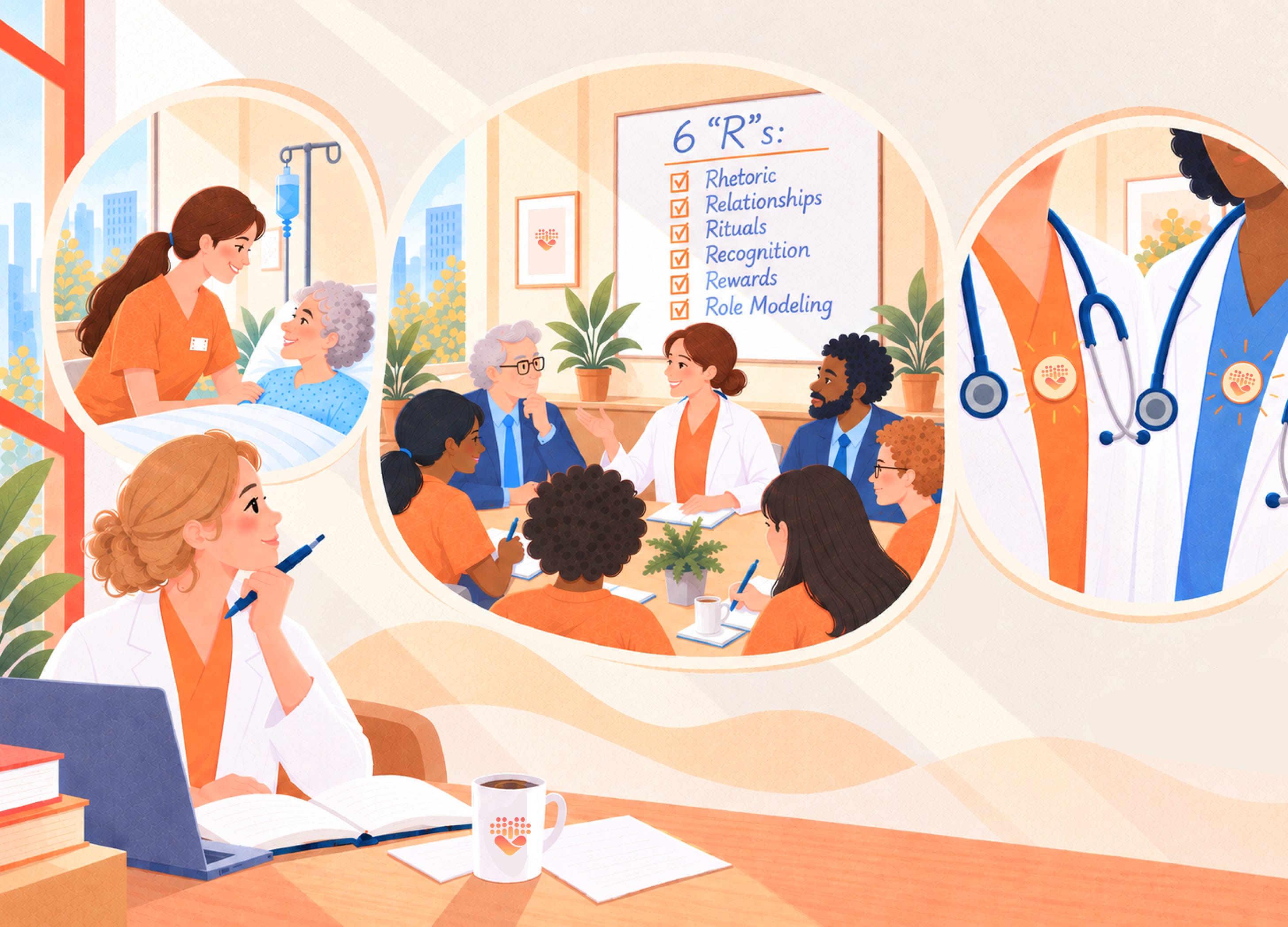
The Illuminators meetings are designed to create those conditions. Using our culture-change practices, which we call the “six R’s”—rhetoric, relationships, rituals, recognition, rewards, and role modeling—we have created a space where people feel comfortable participating, sharing their knowledge and experiences, learning from one another, and experiencing a genuine sense of belonging.
Rhetoric
Words shape culture. We intentionally use language that affirms, connects, and reminds us how we want to lead. Ideas such as “power with” rather than “power over,” and “change travels at the speed of trust,” give people a shared vocabulary for humility, compassion, accountability, and collaboration.
Relationships
Culture travels through relationships. The Illuminators sessions create connections among people who might not otherwise work together. Over time, leaders began reaching across departments without prompting – sharing ideas, solving common problems, and turning a weekly meeting into a growing network of collaboration.
Rituals
Rituals turn values into repeated experiences. Music and a brief well-being moment open each Illuminators meeting, creating space for reflection and human connection before the work begins. These practices remind us that people bring their whole selves to the organization.
Recognition
What people recognize, they repeat. Illuminators nominations celebrate individuals whose actions elevate and connect others. By telling specific stories about these behaviors, we make our values visible and give others examples they can carry into their own work.
Rewards
Rewards communicate what an organization truly values. Formal and informal recognition should reinforce not only what people accomplish, but how they accomplish it. When rewards align with desired behaviors, they help strengthen the culture we want to sustain.
Role Modeling
Culture becomes credible when people see it modeled. Leaders and peers must demonstrate the authenticity, empathy, and vulnerability they hope to inspire in others. There is no single way to do this. Effective role modeling begins with finding a leadership voice that is genuinely your own.
The Conditions for Confidence
The Illuminators meetings began as weekly updates among a small group of leaders. Over time, they became something more: a place where people bring forward meaningful stories, form relationships across boundaries, and learn from one another.
Their influence comes from the Six Rs working together. Rhetoric names the culture we want. Relationships carry it. Rituals make it tangible. Recognition and rewards reinforce it. Role-modeling makes it believable.
Leading these meetings has changed me as well. By creating space for other voices, I found greater confidence in my own. I learned that leadership sometimes looks like helping people see the value in one another and creating the conditions for their ideas to take root.
Institutions can easily lose sight of their people. The Illuminators meetings bring people back into view: as worthy and capable individuals with knowledge, experiences, and light to share. When that happens consistently, people connect, collaboration grows, and culture begins to change.
SOURCES
Van Morrison’s “Warm Love”: Written and performed by Van Morrison; the single was released in April 1973, and the album Hard Nose the Highway (Warner Bros.) in August 1973.
“Micromoments,” Barbara L. Fredrickson, Kenan Distinguished Professor of Psychology at the University of North Carolina at Chapel Hill, Love 2.0: Creating Happiness and Health in Moments of Connection (Hudson Street Press, 2013) and “Love: Positivity Resonance as a Fresh, Evidence-Based Perspective on an Age-Old Topic,” in Handbook of Emotions, 4th ed. (Guilford, 2016), 847–858. The full term is “micro-moments of positivity resonance,” defined as people momentarily sharing “a mutual biological and behavioral surge of warmth, humor, and affection” and a sense of oneness.
Level 1 age-friendly certification from the Institute for Healthcare Improvement: IHI runs Age-Friendly Health Systems with The John A. Hartford Foundation, the American Hospital Association, and the Catholic Health Association. The two levels are “Participant” (Level 1: an approved plan to implement the 4Ms — what matters, medication, mentation, mobility) and “Committed to Care Excellence” (Level 2: three months of counts of older adults who received 4Ms care).
We are a community of practice: The term is Jean Lave and Etienne Wenger’s, from Situated Learning: Legitimate Peripheral Participation (Cambridge University Press, 1991), developed in Wenger, Communities of Practice: Learning, Meaning, and Identity (Cambridge University Press, 1998). See the Wikipedia entry.
We borrowed the name Illuminators from David Brooks: David Brooks, How to Know a Person: The Art of Seeing Others Deeply and Being Deeply Seen (Random House, 2023). Illuminators “shine the brightness of their care on people and make them feel bigger, deeper, respected, and lit up”; Diminishers “see people as objects to be used, not as persons to know and care for.” See “Do you illuminate or diminish people?”, Weave, October 27, 2023.
Our Living and Leading with Love initiative: Peter Pronovost, “Living and Leading with Love: Transforming Healthcare through Mutual Respect and Accountability,” Innovations: Technology, Governance, Globalization 14, nos. 1–2 (2025): 32–54. University Hospitals described the framework publicly in its announcement of a John Templeton Foundation grant, August 26, 2025.
Ideas such as “power with” rather than “power over”: Mary Parker Follett, Creative Experience (Longmans, Green, 1924): “Whereas power usually means power-over, the power of some person or group over some other person or group, it is possible to develop the conception of power-with, a jointly developed power, a co-active, not a coercive power.” See Piera Morlacchi, “The Performative Power of Frictions and New Possibilities: Studying power, performativity and process with Follett’s pragmatism”, Organization Studies, June 28, 2021.
A points system known as My UH Appreciates: “How to Build and Sustain High Performing Teams with Recognition,” Inspirus, June 13, 2025.
The path of Everett Rogers’s adoption life cycle: Diffusion of Innovations (The Free Press, 1962). Geoffrey Moore’s contribution, in Crossing the Chasm (HarperBusiness, 1991), is the chasm between early adopters and the early majority.
The Illuminators is a reader-supported publication. To receive new posts and support my work, consider becoming a free or paid subscriber.