
The Illuminators Credo
American healthcare is in crisis. Fewer than half of patients receive the treatment the evidence recommends for their condition. About one in four hospitalized patients suffers preventable harm — a number that has barely moved in thirty years, while aviation and other high-risk industries made themselves dramatically safer. Some 371,000 Americans die each year from avoidable medical error.
The financial strain runs just as deep. Medical bills are the leading cause of personal bankruptcy in the country, and a single week in the hospital can wipe out a family’s savings. The institutions are no steadier: in 2022, more than half of American hospitals were operating at a loss.
The Illuminators is a reader-supported publication. To receive new posts and support my work, consider becoming a free or paid subscriber.
These problems look insurmountable. They are not. The underlying cause is not a shortage of knowledge, or technology, or money — American healthcare spends more than any system on earth. The deepest problem is an inability to solve complex problems together. And the main reason is a lack of love.
The opposite of love is not hatred. It is separation. Healthcare systems tend to divide the people who most need to connect: physicians from staff, specialists from one another, patients from the people meant to care for them. When people are separated by hierarchy, specialty, or pedigree — when their voices are discounted and their concerns dismissed — a system loses the very capacity it needs to succeed.
Love, in this sense, is not sentiment. It is clarity about who matters and why. Love is a disciplined commitment to treat every person as worthy and capable — and to build the systems that let them experience that worth every day. We do not earn our worth with a degree or a title; each of us is born with it.
Medicine, of all fields, cannot means-test human worth; the ethic of care holds that everyone must be welcomed, healed, and respected. To lead with love is to build a system that acts as if that ideal were true — for everyone, every time. But this does not mean love is soft. It goes hand in hand with accountability. Love demands more, not less, from everyone.
When defined this way and put into practice, love is the most powerful and most neglected lever for transforming the quality, safety, and cost of American medicine. We have seen this proven at University Hospitals, a 15-hospital system headquartered in Cleveland, and we are seeing the idea take shape as a movement across the United States and elsewhere.
At UH, this movement is called Living and Leading with Love. There are more than 400 projects underway, each involving people close to the work, wrestling with complex issues and systems change. Examples include working across internal boundaries to dramatically reduce the occurrence of sepsis. Communicating more effective information about supplements to community residents. Reducing hospital length of stay by adjusting physical therapy and mobility schedules. Adjusting the assignment of operating rooms so they are fully used. Negotiating claim denials by approaching insurance companies collaboratively, on behalf of patients. Empowering nurses to reduce unnecessary paperwork. Helping patients who can’t open their medications by providing more accessible pill boxes.
These may seem like small solutions in themselves, but they add up to effective solutions for complex problems. Healthcare’s establishment has tried to meet these problems with tools that fail: more technology, more metrics, more top-down cost-cutting, more regulation. Those tools fail, because complex problems require collaboration and mutual support, and collaboration requires trust — and trust cannot be mandated. It has to be built.
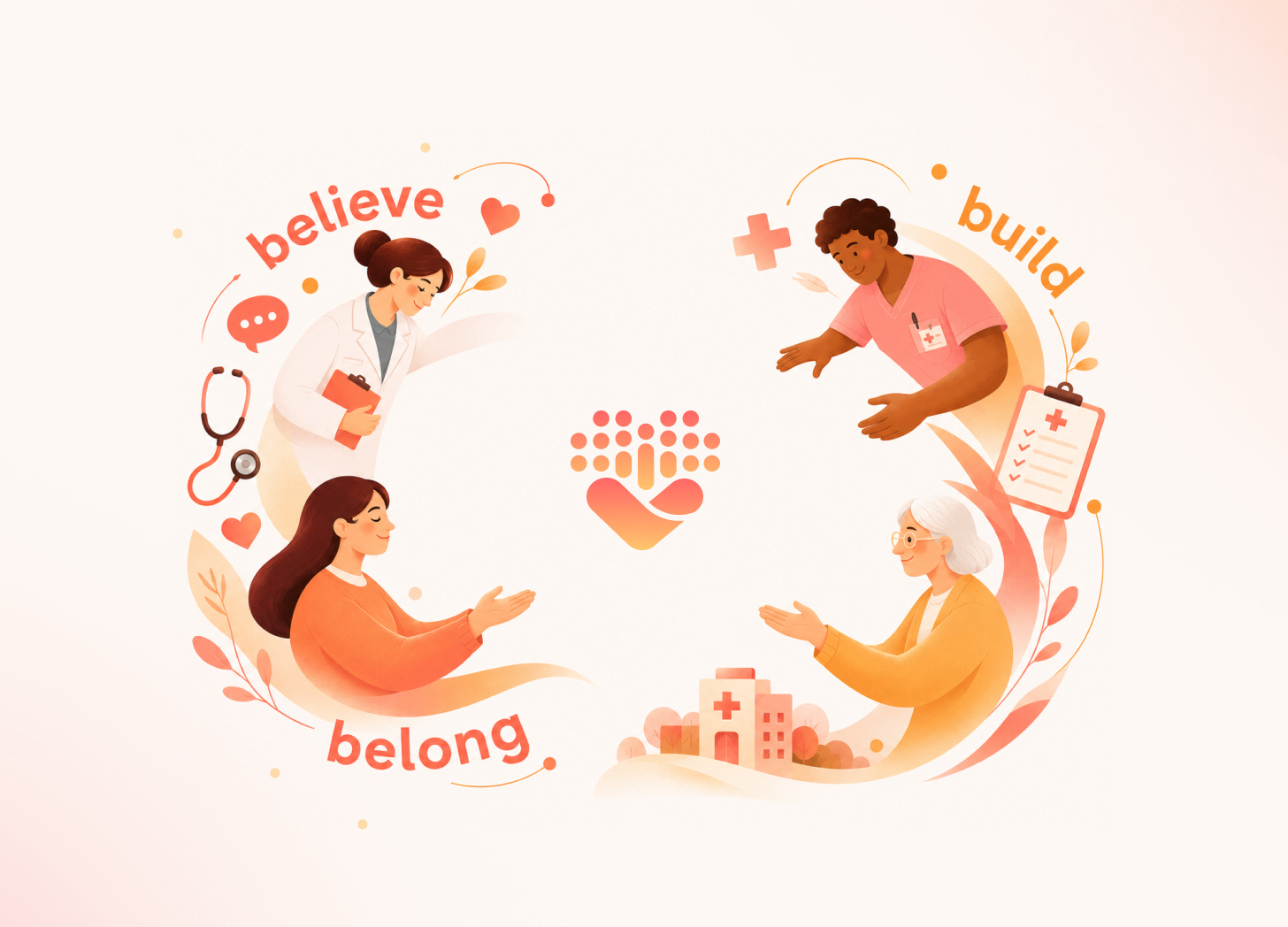
Living and Leading with Love is the discipline of building trust. It rests on three conditions, learned across a twenty-one-hospital system and tested against real results: believe, belong, and build.
Believe is what happens when people shift from seeing a challenge as impossible to saying, “we haven’t figured it out yet.” When physicians and nurses come to believe that zero infections is achievable rather than an inevitable fact of clinical life, and that they can play a role in getting there, they accept responsibility for trying. A leader’s first task is to foster that shared belief — to see what is good in people and reflect it back, rather than making them feel small.
Belong is the free flow of ideas through human connection. Innovation does not come from the top. It comes from the people closest to the work — a housekeeper, a night-shift nurse, a technician in central sterile processing, a physician in a remote hospital — once the organization lets them speak, regularly and openly, across the silos that usually keep them quiet.
Build is the set of management structures that make love and accountability habitual rather than heroic. These include clear goals, clear roles, transparent data anyone can see, regular practices for communicating and celebrating success, and shared accountability that improves systems instead of blaming individuals. Structure is what turns a good week into a habit.
Together, these three transform the relationship with the patient. Conventional healthcare is transactional: the disease is managed, the discharge is booked, and no one is responsible for the person. Relational care is the opposite — the proactive attention that exists only when someone in the system feels genuinely responsible for a patient as a human being. The difference between a patient bankrupted by repeated crises and one who stays healthy at home is rarely technology or diagnosis. It is whether anyone was responsible for her at all.
We have learned, over and over, that quality and cost are not in tension. Love is frugal. Finance tends to look at a budget and see an expense, never asking what return the investment yields — the shorter stays, the freed beds, the crises that never happen. When a system stops separating those things, the numbers move. The University Hospitals system moved in just a few years from $211 million in annual operating losses to financial stability, without cutting staff or chasing high-margin surgery. Medicare cost per patient fell from above the national average to a third below it.
None of it scaled through a hero. It scaled the way a fractal does — the same pattern repeating at every level, everyday leaders running superior teams, one unit adopting another’s discovery until no single person can claim authorship. The people doing this work are called Illuminators, after the writer David Brooks’s distinction: illuminators see what is good in the people around them and reflect it back; diminishers make people feel small. Every Monday at eight in the morning, dozens of people meet — housekeepers beside surgeons, nurses beside executives — to trade what worked and what did not, and to name the illuminators among them.
The movement now travels beyond Cleveland, and beyond healthcare, because the principles are not medical. They are human: dignity, the free flow of ideas, and the conviction that people flourish when they live in communities where everyone gets better. Those are the same principles that partners such as the Stand Together Foundation call the sources of human prosperity.
The initiator of Living and Leading with Love is Peter Pronovost, MD, PhD, FCCM. He is known as a critical-care physician whose patient safety checklist drove central-line infections toward zero, first at Johns Hopkins, then throughout the state of Michigan, then at UH, and now increasingly worldwide. He is one of many leaders in the initiative at UH, and they all agree that a movement like this is broadly based.
To the teams he works with, he says: I believe in you, and I will support you; I will be the wind under your wings, but you must take the lead. He asks of them the three habits he works to practice himself — to be humble, curious, and compassionate.
“Societies flourish when their healthcare system flourishes,” says Dr. Pronovost. “In that sense, it is not just an economically significant industry. It represents science and empathy, professionalism on behalf of people, and a strong belief in the importance of human well-being. When the healthcare system lives and leads with love and practices the principles of prosperity, the rest of society may follow.”
The Illuminators is a reader-supported publication. To receive new posts and support my work, consider becoming a free or paid subscriber.