
From Commanders to Cultivators

By Patrick Runnels, MD, and Brandon Cornuke
The Illuminators is a reader-supported publication. To receive new posts and support my work, consider becoming a free or paid subscriber.
Ahuja Medical Center, a community hospital in a suburb of Cleveland, Ohio, had a customer service problem several years ago. Its patient survey scores were stuck in the bottom one percent. Patients complained of long times sitting in waiting rooms or waiting for staff to respond.
We knew the reasons. The hospital had emerged from the COVID pandemic with a workforce hollowed out by burnout and turnover. Many of its nursing staff were agency workers, technically proficient but strangers to one another and to the institution.
When senior leaders hear this kind of complaint, they typically move right into action. They decide that the problem is staff behavior and form a task force to fix it. They set metrics and hire consultants to deliver mandatory training. The basic idea is to command improvement: to impose controls and demand higher standards of excellence.
The people closest to the work — in this case, the nurses and aides at the hospital bedside, the front-desk staff, and the home care outreach team members —typically experience the new demands as one more job requirement. They comply. The scores inch up a percentile or two. Everyone declares progress, the crisis subsides, and conditions gradually revert back to the way they were before.
That is not what happened here.
Everyone in senior positions at the hospital recognized the need for change—but instead of blaming staff, they resolved to look at their own behavior first. Lindsey Colangelo, the chief nursing officer, proposed an accountability model based on three behavioral changes: humility over ego, curiosity over certainty, and compassion over judgment. “We’re a community hospital,” she later recalled, “and we wanted to feel more like a community.” She declared that she would be a role model herself. For example, she would spend more time on the floor present with people, rather than in her office.
Staffers signed an “eyes up” agreement, specifying behaviors they agreed were important. They would pay attention to people on the floor, rather than to their smartphones. They would avoid labels like “challenging” when talking about patients, and would pay more attention to call lights and people who looked like they needed help. The hospital put peer coaching groups in place so staff members could work on these changes together. Gradually, people on the floor began to feel welcome to speak openly, without rancor or rivalry, and to experiment with new ideas about organizing the workflow.
There was no extra budget for this program. No consultants. No top-down directives or additional technology platform. Yet within six months, the hospital survey scores climbed from the first percentile to above the fiftieth. Its absolute scores rose to 82 percent. All this in an industry where clearing one or two percentage points is considered good progress.
In effect, Ahuja’s people changed their model of leadership. In the past, they had followed the prevailing model of most healthcare organizations: Leader as commander. A small group of top executives is the source of all ideas and opportunities for change. Everyone else implements their directives. Even when people at less senior levels recognize an opportunity for change, it must be accepted, validated, and confirmed by the designated few.
The alternative model is: Leader as cultivator. Ideas and opportunities for improvement emerge at all levels of the organization. Instead of setting high standards for others to follow, the top executives facilitate and enable others. They create a context in which people are intrinsically motivated to set high standards for themselves and unleash their agency and creativity.
This model goes by many names in the management literature: servant leadership, participative leadership, fearless leadership, organizational learning. The results are typically significantly better—so much so that many organizations regularly call for people to “own” their jobs or bring their “whole selves” to work. But while cultivator models may be espoused, the commander approach tends to be the default practice, in hospitals and elsewhere. The frontier of training for senior executives is helping them develop the capabilities for cultivating others’ commitment, so it is available every day in every part of the organization.
Love and Accountability
For the past four years, we have been part of a pioneering, multifaceted effort to bring our organization closer to the cultivator model. The organization is University Hospitals in Cleveland, a system of 15 hospitals (including Ahuja), located across Northern and Eastern Ohio, with about 36,000 employees. In 2022, UH launched a system-wide initiative called Living and Leading with Love, championed by its Chief Quality and Clinical Transformation Officer, Peter Pronovost. Our organization within UH, the Veale Healthcare Transformation Institute, coordinates research, learning and development related to fundamental improvement of healthcare quality at UH.
There are more than 400 projects underway at UH, all of which evoke the model of leader as cultivator. The peer accountability effort at Ahuja is one of them. These projects are led by people who are close to the work, often initiating the project themselves. Examples include teams of nurses establishing practices for zero harm; regional hospital administrators developing protocols for quality care; and cross-functional teams working on improvements to outmoded practices. A pharmacist and a rehab team collaborated to stock easy-to-open pill bottles for patients with limited hand strength. A home care division moved from consistent losses to profitability by bringing everyone together regularly with operating data to talk through improvements. Front-desk staff at 43 clinics discovered they were entering the same data in different IT systems, which cost the hospital group $3 million per year in declined claims. They designed a new workflow themselves instead of waiting for a vendor.
The Living and Leading with Love Initiative at UH is associated with achieving results that would otherwise be considered impossible to achieve. Surgical complications have dropped by 70 percent. Medicare costs per patient dropped to 33 percent below the national average while quality scores soared. The UH system, which was losing $211 million, achieved financial stability, ultimately saving $55 million above target in just three years.
We have consistently found that the cultivator model of leadership plays a major role in achieving these results. The leadership literature supports our conclusion. Management research is remarkably consistent on the transformative value of this leadership model. The research is largely qualitative — measuring traits, correlating them with long-term financial performance — but the pattern is clear across decades of work, by researchers such as Jim Collins, Amy Edmondson, Daniel Goleman, Richard Boyatzis, and Annie McKee.
Top-Down and Bottom-Up
Although many organizational leaders favor the cultivator model in principle, they don’t always elevate leaders who operate that way. Nor do they always recognize why it is more effective. Figure 1 shows the dynamics that explain the difference.
Figure 1: Two models of management in health care systems
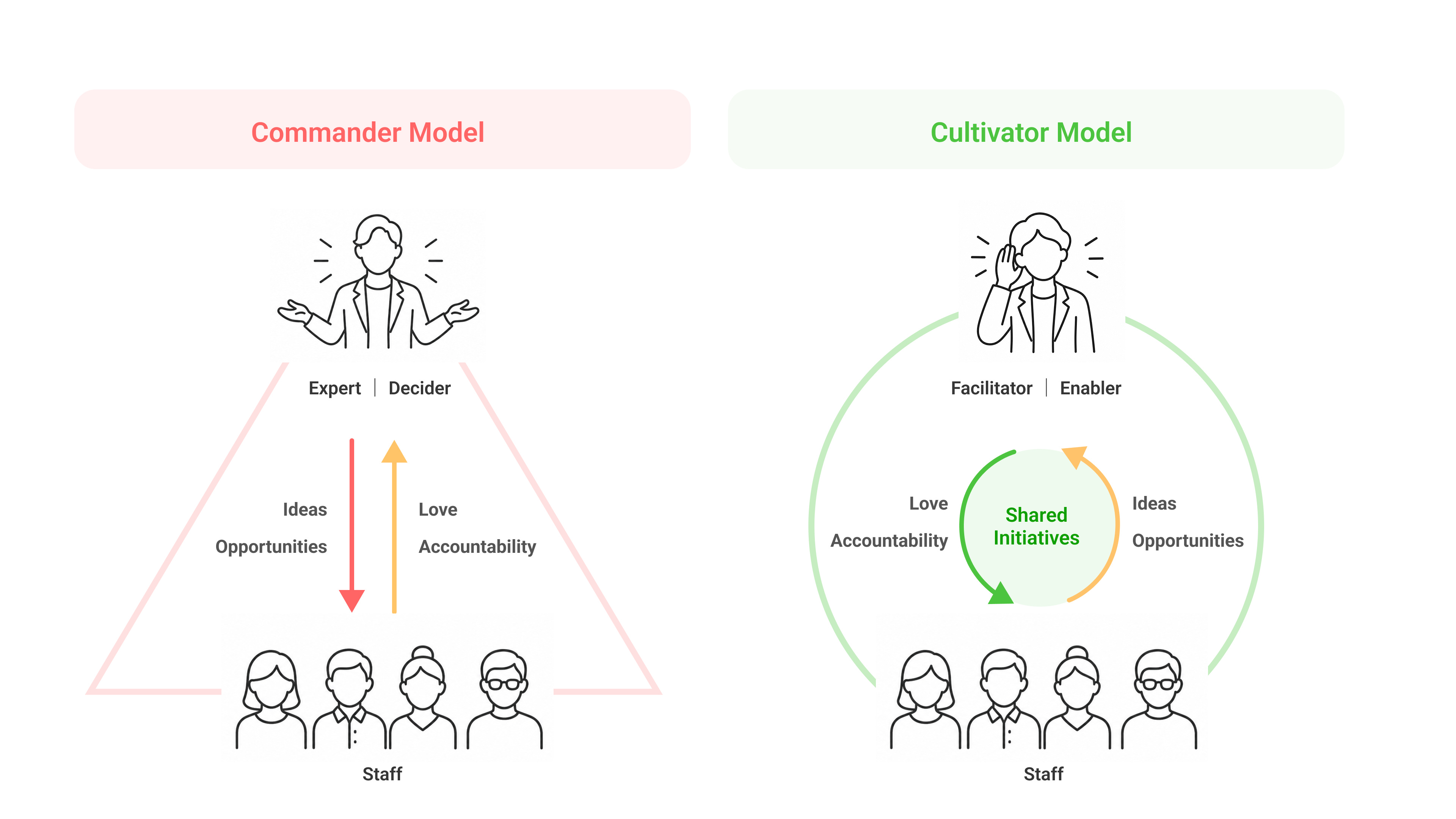
On the left side of the diagram is an archetype of the hierarchical, commander model. It is the model most executives were trained to follow and, if we are honest, the model we tend to default to under pressure. Top leadership speaks; everyone else listens. There is an implicit but clearly understood bargain:
As top leaders, we supply the all ideas and opportunities that are needed. This includes knowledge of what matters, directions to follow, and actions to take. You, the team members, are accountable for executing those ideas and accepting the opportunities given to you. In exchange, you are responsible for all the emotionally resonant aspects of our working relationship, labeled “love.” This includes loyalty, respect, and trust. In addition, you are accountable for your performance and for the results. Love and accountability flow upward, as if you owe them to us in exchange for our directives and your paycheck.
Most healthcare organizations follow this archetype without reflecting on it. When there’s a problem, leaders instill tighter controls, more directives, and, at times, layoffs — all of which are felt as punishment. We then wonder why trust erodes, why people withdraw, and why the best clinicians and bedside practitioners either leave or express dissatisfaction.
Now look at the right side of Figure 1. The cultivator archetype turns the flow into a cycle of mutual commitment. Love and accountability flow downward. The definition of love changes to become more universal: it is now related to unconditional regard, the genuine belief that every person in the organization is worthy and capable. Under the cultivator model, leaders do not take responsibility for generating ideas or identifying opportunities. Instead, they create spaces where others feel free to innovate, and where the voices closest to the work are heard. Accountability flows from senior leadership: if something is not working well, they assume responsibility for making sure the necessary changes are made.
That does not mean the top leaders are the source of knowledge. Instead, the leader acts accountable to those lower in the hierarchy; those closest to the work are trusted to provide decisions and ideas. Because the whole system is more open, all four elements—love, accountability, ideas, and opportunities—continue to circulate, often in the form of shared initiatives that generate continuous improvement and better outcomes.
The archetypes represent extremes. In reality, there is no such thing as a purely top-down or bottom-up organization. But most healthcare organizations tend to gravitate to one or the other. The commander model reflects the myth of the magic leader: a singular genius whose brilliance justifies enormous compensation, unchecked authority, and a management style that would be recognized as destructive in any other context. By contrast, cultivators are revered for their ability to bring out genius in the others around them. They still make decisions, but they base those choices on what the organization knows, not what they alone believe.
Consider Steve Jobs. In his first tenure as Apple’s CEO, Jobs considered himself to be the most important idea man, the visionary, the singular source of direction. He was also, by most accounts, impossible to work with — and he was fired by his own board. When he returned to Apple a decade after leaving, he deliberately overrode his own commander tendencies to facilitate and enable others. Ed Catmull, who co-founded Pixar with him, later recalled how Jobs would step back from disagreements and let his colleagues make the decisions, without revisiting the disputes later. The new leadership approach was key to Jobs’s rebound. Apple became, during his second tenure, one of the most successful companies in history.
We see the same patterns in other industries—including a few cases where the change was forced. Kevin Hancock is the sixth-generation CEO of Hancock Lumber, a Maine company in business since 1848. He led his company in conventional command-and-control fashion until 2010, when a rare neurological condition called spasmodic dysphonia stripped him of his voice during the housing collapse, a period of enormous tension. Unable to issue directives, he began listening and occasionally asking questions instead, and discovered that the people closest to the work usually knew what to do. What they had needed from him was not direction but the trust and cultural safety to act on their own judgment. Hancock formalized the approach as shared leadership, made employee engagement his top metric, and between 2012 and 2020 the company earned more than it had in its first 163 years of operation.
“People already knew what to do,” he said at a conference of chief executives. “It turned out they hardly ever actually needed a top-down, CEO-centric directive. What they really needed was the encouragement, the trust and the cultural safety to follow their own voice.”
Leading as a Cultivator
These two leadership archetypes do not merely produce different outcomes. They feel different — to leaders, to staff, and to patients. Walk into a unit led with the cultivator model, and you will sense it from the atmosphere. People talk to each other more openly. They know they are valued. There is an alertness in the room that has nothing to do with fear and everything to do with engagement.
When it isn’t blocked, this style tends to spread almost virally, until it operates at every level of the organization — not as a philosophy pushed from the top, but as a set of behaviors that people choose to emulate.
This model works because it fits many aspects of human cognition. Social baseline theory, developed by the neuroscientist James Coan, holds that the human brain did not evolve to operate optimally in isolation. It evolved to operate optimally in trusting, reciprocal relationships. When people work alongside others they trust, the same task requires less cognitive effort, to an extent that is visible on an fMRI. Absent those relationships, people become, in Coan’s framing, measurably less capable and significantly less innovative.
Maria Feddeck, researcher at Case Western Reserve’s Weatherhead School of Management, has studied burnout among physicians in the UH system. She found a striking correlation: the feeling of belonging was the foundational condition for people to experience their work as generative rather than depleting. Everything else — workload, compensation, autonomy — mattered, but belonging came first. The cultivator model helps people reach that state.
In general, when leaders adopt the cultivator model, it changes the way they communicate. They express genuine gratitude and interest in staff development. They accept responsibility for performance issues, rather than cascading blame down the hierarchy. Staff members respond with energy. They feel empowered to speak up and valued when they do. And they begin to contribute what no top-down directive could ever produce: the inspired ideas, the local knowledge, the daring innovations that come only from engaged people who are close to the patient, the customer, the problem.
Another neuroscience factor helps explain why this type of leadership is effective, especially for senior executives. As people get older, their brains get better at pattern recognition — finding signal amid noise, identifying which of a thousand inputs deserves attention. A leader in their fifties or sixties who uses that pattern recognition to surface and amplify the insights of others is working with the grain of their own neurology rather than against it. The commander model asks aging leaders to keep generating ideas as if they were 30 years old. The cultivator model asks them to do what their brains are well-suited to: recognizing excellence in others and creating the conditions for it to flourish.
Of course, there are situations that genuinely require decisive direction from a single authoritative commander: for example, a crisis in the ICU or a power shortage during a procedure. At those times, people expect someone accountable to step up as a decisive, expert commander, because there is no time to deliberate. The capacity to do this is already well developed in most healthcare cultures, but other qualities are often lacking: the judgment to recognize which mode the moment requires, and the practiced ability to incorporate both gracefully into a single leadership style. The most effective leaders tend to default to the cultivator model, draw on the commander model when genuine emergencies demand it, and move between the two smoothly and appropriately. That integration is a hallmark of high-quality leadership.
Why the Commander Model Persists
If the cultivator model produces better results overall and feels better in practice — and the evidence, from Collins to Edmondson to Goleman, Boyatzis, and McKee to UH and elsewhere, is remarkably consistent— then why does the commander model dominate most organizations? Why do we keep selecting, rewarding, and celebrating leaders who constrain the capabilities we need?
The answer is not ignorance. Many senior leaders have been exposed to the idea of participative leadership. They recognize its value intellectually. However, the commander model fits with psychological and organizational needs that have nothing to do with performance. These needs reinforce one another, creating a system of resistance that is far more formidable than any single barrier would be.
The commander model appeals to a human impulse for protection in a dangerous world. People who see the world as full of danger are more likely to be drawn to strong, decisive, authoritative leaders, viewing their controlling nature as a necessary means to ensure safety and stability. Those who recruit leaders—such as CEOs and boards—may seek out commanders because, at some level, they believe staff need strong controls.
The commander model is associated with heroic archetypes. People tend to think of charisma, domination, and strength as leadership qualities. There is something reassuring about a leader who projects certainty and appears to have the answers to any problem. If an organization advances leaders who are adept at self-promotion, it is unconsciously selecting for commanders. In healthcare, this expectation is amplified by the nature of clinical training. Physicians advance when they seem to know more than anyone else in the room, can recall information under pressure, and appear confident in making life-or-death decisions. The pipeline selects for expert decision makers at every stage and rewards them at every turn.
Current incentives and metrics are biased to support the commander model. Performance reviews, rewards, and financial data often reinforce it. For example, one visible way to cut costs is to reduce headcount, which is typically a commander move: a rapid, decisive way to gain short-term results, often with unintended consequences for the long term. Conversely, the qualities of a skillful cultivator—such as the humility, curiosity, and compassion specified in the peer learning process at Ahuja hospital—don’t show up immediately in performance data.
As leaders rise in the hierarchy, they may lose their capacity to cultivate others. Even well-intentioned leaders may succumb to this dynamic, which is substantiated by research spanning neuroscience, social psychology, and management science. Adam Galinsky and his colleagues at Columbia demonstrated that gaining power reduces perspective-taking: there is less need to understand how others see, think, and feel. Sukhvinder Obhi, a neuroscientist at Wilfrid Laurier University, found that the neural mechanism of empathy — the mirror system that activates when we observe another person’s actions — is dampened in people who feel powerful. In general, as people rise in the hierarchy, they are less driven to practice the inclusive, facilitative behavior that the cultivator model requires.
In some corporate cultures, the cultivator model is regarded as risky. Leaders who pause to listen, surface problems rather than suppressing them, share credit, and absorb blame may expose themselves to disrespect. They may come across as weak, disingenuous, insincere or “showboating.”
Supporting the Cultivator Model
The forces resisting the cultivator model are formidable. Yet every one of them can be addressed — not by dismantling the commander model outright, but by creating conditions under which the cultivator model can take root, prove itself, and spread. The work is neither fast nor simple, but it follows a logic that we have seen operate in our own organization and that is consistent with the broader research on sustained culture change.
Leaders can take the following steps:
Embrace the cultivator approach by name. Most leaders do not consciously choose the commander model for their own behavior. They default to it, because they think it’s how they’re supposed to act. By naming the two models and asking leaders to locate themselves honestly on the spectrum between them, we change the conversation.
Openly talk about the values associated with the cultivator model. At heart, it is an expression of conviction — about the value of people, about the source of good ideas, about where accountability should reside. This conviction cannot be imposed from above. If the leaders who implement these changes do not genuinely believe that the people they lead are worthy and capable, the changes will not stick.
Set an example in day-to-day practice. Intellectual awareness should be bolstered by direct experience. “We talk about this stuff all the time,” said Charles Ingoglia, the founder and president of the National Council for Mental Well-Being. “Talking is not sufficient.” Model the approach in your own behavior and set up situations where people can practice it, as Lindsey Colangelo did in the peer coaching program.
Although it’s a bottom-up model, the cultivator approach cannot take hold without top-down support. At least one senior leader — ideally the CEO, but at minimum someone with the authority and visibility to set the tone — must be willing to practice it openly, absorb the risks, and demonstrate a commitment to the model through action.
Visibly reverse the status quo. In the commander model, accountability flows upward: “If we don’t hit our numbers, you’ll be held responsible.” But in the cultivator model, accountability accrues to the top leaders first. They are responsible for creating the conditions that enable their teams to thrive. A CEO might say something like this: “If we don’t get our numbers, it’s on me. But I trust that you are a great team. I’m going to support you, and in return, I want your ideas and ideally your commitment.” That is not a softer form of leadership. It is a harder one — because the leader is accepting responsibility for outcomes while ceding control over how those outcomes are achieved.
Create spaces where people can flourish. This model depends on having a high level of psychological safety. Sensitive and politically charged issues inevitably come to the surface. Even highly emotionally intelligent individuals will hold back unless they are sure they will not be penalized or blamed.
Redesign the organizational structures: reporting relationships, promotion criteria, and reward systems. When leaders are evaluated not only on financial performance but on the development of their people, on the quality of ideas surfacing from below, on the retention and engagement of their teams, the signals change. When bonus structures reward collaboration rather than individual heroics, people set different priorities. This was demonstrated powerfully in Lynda Gratton’s Collaborative Advantage Research project.
Becoming a Cultivator
In the broader healthcare field, three groups of people are well-positioned to take these steps. First, aspiring leaders seeking career positions can gravitate toward organizations that demonstrate a cultivator model in practice. These are the organizations who respond affirmatively when you ask if people are respected for their ability to make decisions and raise ideas. Second, executive leaders can look to recruit and elevate those who have demonstrated performance with a cultivator approach. Third, boards and executives can explicitly seek top leaders who champion or exhibit participative values.
The cultivator model requires a commitment to leadership development. Skills like coaching, visionary framing, engaging people and fostering shared accountability are not familiar to many people. They usually require training and explicit practice.
One powerful mechanism at UH has been peer-to-peer training within our Transformational Leadership Academy. We teach the content of culture change — the research, the frameworks, the evidence — to people at every level of the hierarchy. The most important component is modeling the behaviors we want to see. During the sessions, we encourage people to challenge us. We explicitly demonstrate vulnerability, talking about what we have had to change, as an example of a shift in our presence. We invite individuals to verbalize doubts then celebrate their courage while inviting others to make cogent rebuttals.
In the second year of the program, something happened that neither of us had anticipated. The participants began observing not just what we said but what we did. They noticed the way we listened, the way we responded to challenge, and the way we treated them. “You’re not just teaching us about love,” one of them said. “You love us. I can feel it when you teach.” This comment, in a formal course, was one more example of the way the cultivator model affects people.
James O’Toole, the leadership scholar, argues that sustained organizational change requires three elements operating simultaneously: a visionary leader who articulates and models the new direction; methods and tools that make the new behaviors concrete and replicable; and a governance structure that institutionalizes them so they survive the departure of any single leader. All three are necessary. None is sufficient alone.
But even O’Toole’s framework operates within a constraint that no framework can remove: you can require compliance, but you cannot require commitment. The cultivator model asks leaders to believe something about the people they lead — that they are worthy and capable — and to act on that belief even when the evidence is ambiguous and the pressures to revert are intense. That belief is a choice. It is made individually, in the privacy of one’s own leadership practice, and it is remade every day. The CEO’s job is not to compel it. The CEO’s job is to set an example, create a space, and give people room to make that choice on their own.
The choice is available to every leader, in every organization, at every stage of a career. It requires no new technology, no massive restructuring, no act of corporate heroism. It requires only a willingness to ask a question that most leaders find unexpectedly difficult: What if the best ideas are not mine?
About the Authors
Patrick Runnels, MD is a psychiatrist who helped make University Hospitals one of the nation’s most successful accountable care organizations (with nearly $200 million in shared savings) by caring for its most complex patients better, not less. As Chief Medical Officer of the Veale Healthcare Transformation Institute and a professor of psychiatry at Case Western Reserve, he founded UH’s Clinical Leadership and Transformation Academy and writes on how leaders cultivate change instead of commanding it.
Brandon Cornuke is an innovation strategist, adjunct professor of design and innovation at Case Western’s Weatherhead School, and author of The Value Proposition Matrix. At University Hospitals he works at the seam between UH Ventures and the Office of Transformation, turning frontline ideas into working systems: the practical engine behind cultivating, rather than controlling, change.
Sources:
Ahuja Hospital:
Peter Pronovost, remarks, University Hospitals Illuminators Meeting, March 16, 2026 (transcript on file with the authors).
Interview with Lindsey Colangelo.
Other names for the cultivator leadership model:
Greenleaf, Robert K. (1970). The servant as leader. Center for Applied Studies.
Greenleaf, Robert K. (1977). Servant leadership: A journey into the nature of legitimate power and greatness. Paulist Press.
Lewin, Kurt, Ronald Lippitt, and Ralph K. White (1939). “Patterns of aggressive behavior in experimentally created social climates.” Journal of Social Psychology, 10(2): 269–299.
Likert, Rensis (1961). New patterns of management. McGraw-Hill.
Argyris, Chris, and Donald A. Schön (1978). Organizational learning: A theory of action perspective. Addison-Wesley.
Senge, Peter M. (1990). The fifth discipline: The art and practice of the learning organization. Doubleday/Currency.
Edmondson, Amy C. (2018). The fearless organization: Creating psychological safety in the workplace for learning, innovation, and growth. Wiley.
For an overview, see Yukl, Gary (2019). Leadership in organizations, 9th ed. Pearson.
Living and Leading with Love initiative:
Pronovost, Peter (2025). “Living and leading with love: Transforming healthcare through mutual respect and accountability.” Innovations: Technology, Governance, Globalization, 14(1/2): 32–54.
Transformative value of cultivator leadership:
Collins, Jim (2001). Good to great: Why some companies make the leap... and others don’t. HarperBusiness.
Goleman, Daniel, Richard Boyatzis, and Annie McKee (2002). Primal leadership: Realizing the power of emotional intelligence. Harvard Business Review Press.
Steve Jobs:
Isaacson, Walter (2011). Steve Jobs. Simon & Schuster.
Catmull, Ed, with Amy Wallace (2014). Creativity, Inc.: Overcoming the unseen forces that stand in the way of true inspiration. Random House.
Kevin Hancock:
Prince, C. J. (2025). “The CEO who lost his voice—and found a new model for leadership.” Chief Executive. March 27. https://chiefexecutive.net/the-ceo-who-lost-his-voice-and-found-a-new-model-for-leadership/
Social baseline theory:
Beckes, Lane, and James A. Coan (2011). “Social baseline theory: The role of social proximity in emotion and economy of action.” Social and Personality Psychology Compass, 5(12): 976–988. https://doi.org/10.1111/j.1751-9004.2011.00400.x.
Coan, James A., Hillary S. Schaefer, and Richard J. Davidson (2006). “Lending a hand: Social regulation of the neural response to threat.” Psychological Science, 17(12): 1032–1039. https://doi.org/10.1111/j.1467-9280.2006.01832.x
Belonging and burnout among physicians:
Feddeck, Maria Volkova. Unpublished research, Weatherhead School of Management, Case Western Reserve University. https://case.edu/weatherhead/about/faculty-and-staff-directory/maria-volkova-feddeck
Applicability of cultivator leadership for senior executives:
Park, Denise C., and Patricia Reuter-Lorenz (2009). “The adaptive brain: Aging and neurocognitive scaffolding.” Annual Review of Psychology, 60: 173–196. https://doi.org/10.1146/annurev.psych.59.103006.093656
Appeal of the commander model:
Mirowska, Agata, Raymond B. Chiu, and Rick D. Hackett (2022). “The allure of tyrannical leaders: Moral foundations, belief in a dangerous world, and follower gender.” Journal of Business Ethics, 181(2): 355–374. https://doi.org/10.1007/s10551-021-04963-5
Capacity to cultivate others erodes as leaders rise in the hierarchy:
Galinsky, Adam D., Deborah H. Gruenfeld, Joe C. Magee, and M. Ena Inesi (2006). “Power and perspectives not taken.” Psychological Science, 17(12): 1068–1074. https://doi.org/10.1111/j.1467-9280.2006.01824.x
Hogeveen, Jeremy, Michael Inzlicht, and Sukhvinder S. Obhi (2014). “Power changes how the brain responds to others.” Journal of Experimental Psychology: General, 143(2): 755–762. https://doi.org/10.1037/a0033477
“Talking is not sufficient:”
Ingoglia, Charles. Personal communication.
Collaborative advantage:
Gratton, Lynda (2005). “How to build collaborative advantage.” MIT Sloan Management Review, 46(3): 22–30. https://sloanreview.mit.edu/article/how-to-build-collaborative-advantage/;
Gratton, Lynda (2007). Hot spots: Why some teams, workplaces, and organizations buzz with energy—and others don’t. Berrett-Koehler.
Three elements for sustained organizational change: O’Toole, James (2019). “The short life of enlightened leadership (and how to extend it).” strategy+business, 94, February 11. https://www.strategy-business.com/article/The-Short-Life-of-Enlightened-Leadership-and-How-to-Extend-It
O’Toole, James (2019). The enlightened capitalists: Cautionary tales of business pioneers who tried to do well by doing good. HarperBusiness.
The Illuminators is a reader-supported publication. To receive new posts and support my work, consider becoming a free or paid subscriber.