
Fostering a Culture of Mobility
Karen Bitzer, MBA, OTR/L, and Julia Skarbinski, MBA, BSN, RN
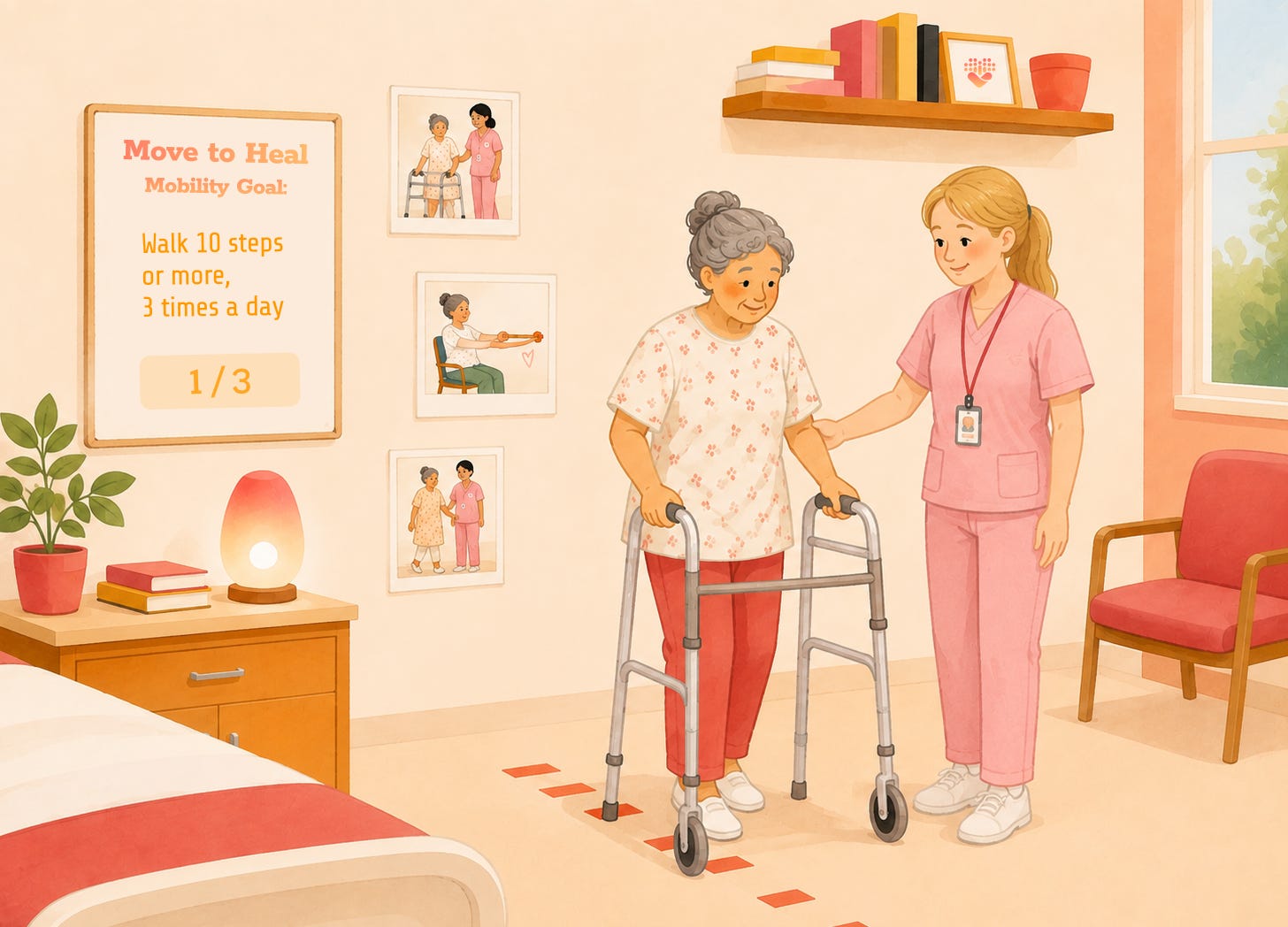
A physician, about to do rounds, stops inside the door and looks at a placard on the wall. There are two figures posted. The patient’s mobility goal says “walk ten steps or more, three times a day.” Today’s tally, so far, is zero. If you’re the patient, you can see this from your bed. Everyone else can see it, too: the physical therapist, the mobility aide who arrives at eleven, the spouse who visits after work, and the nurse who has been on the floor since seven o’clock.
“Tell me how you’re moving,” says the doctor. “When was the last time you got out of bed?” This is your cue to talk about how strong you feel and how you feel about your recovery in general. The nurse or a mobility aide helps you stand up, and gives you a wireless monitor that follows you down the corridor. If you cannot walk or sit up, they work with you to move your hands and legs. You get the message. You’re supposed to be moving regularly, people are keeping track of your exercise, and it’s not just the motion that matters. It’s the more energetic, hopeful attitude that goes with getting up and moving, that will lead you to a faster recovery.
The staff are also being tracked. Your faster recovery is a part of a larger story for the whole hospital, including more secure financial footing because of overall reductions in length of stay and fewer complications. Everyone is scored on compliance with your goals, but no one is blamed if the score falters, because the score is not seen as just a number on a dashboard. It is a commitment made by everyone in the room, including you as the patient, to one another.
Evidence consistently shows that mobility is one of the most effective things that a healthcare system can champion for patients. Nonetheless, for a busy hospital staff member, increasing patient mobility can feel like a burden. It’s not always easy to get patients dressed and moving, and it requires support structures to make sure it happens regularly. This in turn requires leaders from separate disciplines—medicine, nursing, physical therapy, data, and information technology—to build a system that supports mobility as a way of life in the hospital.
In this collaborative article, two leaders at University Hospitals tell the story of its Move to Heal initiative: how it started strong before COVID struck, how it faltered after the pandemic, how they built it back with UH’s Living and Leading with Love approach, and how they are now partnering with the Parkinson’s Foundation to pioneer research that helps those mobility efforts improve.
Karen Bitzer, MBA, OTR/L, is an occupational therapist and the Director of Inpatient Rehabilitation for the University Hospitals Health System. Julia Skarbinski, MBA, BSN, RN, is the Senior Director of Clinical Risk and Loss Control. Both were deeply involved in the development and launch of Move to Heal, and in the ongoing research about it. They are among the coauthors of the first research paper published on this effort (see sources below), and continue to be champions of the initiative going forward. Many hospitals seek to develop mobility programs, and they often succeed to a small extent; but to achieve the kind of results that make a lasting difference—to patient outcomes and to the professionals responsible for those outcomes—you need the kind of comprehensive, evolving initiative described in this story.
—Peter Pronovost, MD, PhD, FCCM
The Many Benefits of Movement
Karen Bitzer: Our original Move to Heal program launched in 2019. It was a response to a proposed Medicare change to bundled care: hospitals would become responsible not just for their own costs, but for the costs incurred for a span of time following the patient’s discharge. For example, costs incurred at a skilled nursing facility or rehabilitation center. We were asked to make it feasible to help more people recover at home.
The Illuminators is a reader-supported publication. To receive new posts and support my work, consider becoming a free or paid subscriber.
Peter Pronovost had just joined us as Chief Quality and Clinical Transformation Officer. He had previously been at Johns Hopkins, where he had done a lot of work with early patient mobilization. The evidence showed that if you get patients up and moving early, even patients in intensive care who are fairly ill, they have better outcomes.
Julia Skarbinski: There are many reasons for emphasizing movement. It reduces complications: bedsores, blood clots, depression, and cognitive decline. If you’re not exercising your lungs as much, that can lead to pneumonia. Critically ill patients lose nearly 2 percent of their skeletal muscle each day during the first week of an ICU admission, and patients who don’t walk can lose 2 to 5 percent of their muscle mass during their stay. Moving helps people stay balanced and prevents falls later. It contributes to better sleep, it improves focus, and it reduces constipation. Most importantly, people who don’t move tend to fall into a mindset of being sick. Moving makes them feel like they’re closer to recovering and going home.
The quality of life piece is personal for many of us. Not long ago, I met a man at a wedding who was dancing with his granddaughter, driving, and very independent. Then he was admitted to a hospital (not one of our hospitals) for six days, for treatment of a newly diagnosed cancer. His family visited him every day, and he was always lying in bed without moving. His prognosis was good, but when it came time for him to go home, and his daughter came to pick him up and help him get dressed, he could not even balance to sit up in bed. He had deteriorated that much. It took several people to move him to the wheelchair, and several people to get him from the car to the house. That night, when he tried to walk, he fell and they had to call emergency medical services and take him back to the hospital. He passed away not long afterwards. It was clear to us, in retrospect, that if his family had advocated for him moving, even when he didn’t feel like it, he would have had a much better chance.
Karen Bitzer: In 2019, I attended a course on mobility at Johns Hopkins, and brought that information back to UH. We rolled out our own adaptation, which we still follow. We use the Activity Measure for Post-Acute Care (AM-PAC), an instrument with two six-question scales, one for basic mobility and one for daily activity. When patients are admitted, nurses use those scales to set the patient’s daily goal for mobility and for daily living activities while they’re in the hospital.
We also use the AM-PAC score to assign someone to be accountable for mobility. A patient who scores 22 or higher—someone otherwise healthy who came in with pneumonia, say—is capable enough that nursing can manage their daily mobility. A patient who scores 21 or below, or who has a more complex condition such as recovery from a hip replacement or a stroke, is overseen by a physical or occupational therapist, with a more specialized level of skill.
From the start, the Move to Heal program was based on teamwork: the physicians, nursing, PT, OT, the patients, and their families and friends who came to visit. Communication was key. Whoever was accountable for the patient’s mobility—sometimes a therapist, sometimes a nurse—would set the goal and write it on a card in the patient’s room. Throughout the day, as people interacted with the patient, they would update that card. The physician, staff, family, and patient could all see the goal and the progress.
Day-to-day mobility can be challenging. It takes time to make sure the patients have their gowns or robes on, and to adjust their oxygen tubing so they can go out to the hallway. Some patients resist. It’s up to the nurse or the therapist to say, “It’s in your best interest to get up and move—and it’s part of our culture.” Having the data on the wall made it easier to do this.
Setbacks and Renewal
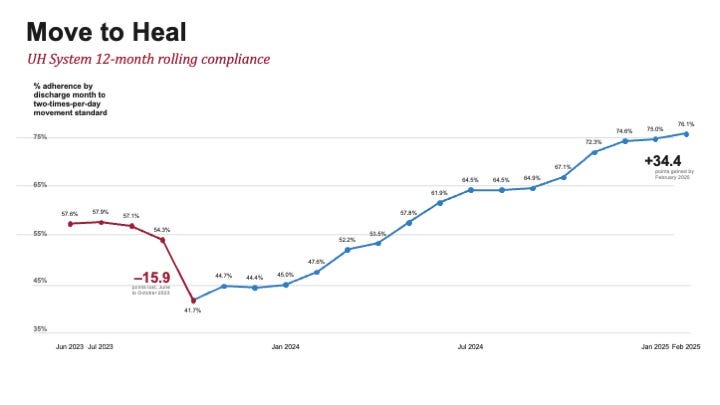
Karen Bitzer: We were just making headway with compliance when the pandemic hit. We continued Move to Heal, but it was very hard to keep focused on mobility when there were so many more urgent needs related to COVID. As late as 2023, we were still feeling the impact from COVID on nurse staffing. The hospital system relied on more contract and travel nursing, and our Move to Heal compliance numbers fell. (See Figure 1.)
Figure 1: Move to Heal compliance, June 2023 to February 2025.
As it happened, new capabilities arrived around the same time our numbers were bottoming out. In October 2023, University Hospitals went live with Epic, a comprehensive electronic health record system that gave us real-time data on every patient, including how often each one moved.
Now we could go beyond wall cards. At a glance, the nurses and physical therapists could see the data for every patient without going to their room. We could see who hadn’t received a mobility session. The data also showed us the larger picture: which hospitals were adhering to the Move to Heal standards in practice, and which were not. It turned out that some teams were overestimating their compliance, and others were doing better than anyone thought. With the data, it became much easier to know what was happening at the bedside.
Julia Skarbinski: As we went onto Epic, we saw that there was a lot of variation among units. Some were very low, moving only 10 percent of patients twice a day. Others were up in the 40 percent range. On average, system-wide Move to Heal compliance had fallen to 41.7 percent. That meant fewer than half our patients across the UH system were moving their bodies twice a day.
We resolved to bring our scores back up. We set a goal of 70 percent compliance with this twice-a-day standard. By the end of 2024 we were 72.5 percent compliant, and then we decided to move the needle and make it more challenging. For 2025, we moved our goal to 80 percent compliance with movement three times a day.
The three-times-per-day goal came from the Parkinson’s Foundation. It issues hospital care recommendations for patients with Parkinson’s disease, a group for whom mobility is particularly important. We decided to match their standard by adding one session per day to patient schedules.
As the chart shows, our system-wide compliance climbed back up to more than 76 percent within 16 months. It has continued to improve. By mid-2026, it was close to 90 percent, even when measured against the more rigorous standard of three times per day. We have thus surpassed the goal set by our OKRs.
Practices That Reinforce Mobility
Julia Skarbinski: It was not a single factor that enabled this improvement. It was a comprehensive effort, aligned with the Living and Leading with Love movement emerging at UH. We set out to mobilize all of our clinicians at UH—nurses, physical and occupational therapists, and physicians—to build the program together. We developed what we call a fractal management approach: people at each hospital take the lead and organize the work in their own way, but with a high level of communication and a common set of practices and principles.
We built out our management infrastructure to support this, starting with a shared group of objectives and key results (OKRs) that we developed across all our hospitals. We hold system-wide regular meetings on mobility among the chief nursing officers from every facility. There are also regular meetings for the nurse managers within every facility, and then floor or unit meetings for the staff who move patients. We talk about the challenges we’re seeing, and learn from one another.
We also returned to a process called triad rounding, in which the physician and managing nurse visit together with each patient on the unit. It seemed old school at first. Most hospitals have gotten away from it. But what’s old is new again, and it is great for helping patients move.
During the triad round, the doctor can ask the patient, “When was the last time you moved?” If the patient says, “I haven’t been out of bed today,” the nurse is right there. All members of the bedside team, and the patient, are reminded that they are accountable, together, for the recovery.
Karen Bitzer: We explicitly pulled together the nursing, occupational therapy and physical therapy disciplines, with the patient at the center. We integrate movement with the tasks that already have to be done. For example, we try to help patients sit up and move to a chair for their meals. Who wants to eat lying down in bed? It’s not good for your swallowing mechanism. It’s not comfortable.
We bring in mobility aides, for patients who need a moderate amount of help. Their job is to get patients up and moving on the floor or within their room, depending on the goals. We have also introduced portable monitors so patients can move anywhere on the unit—to the physical therapy gym, for example—and still be monitored.
We also work with patients’ families. If a patient doesn’t have significant safety needs, we encourage a spouse to walk the halls with them. That helps people engage, and they know what to expect when the patient is discharged home.
Move to Heal is a passion project for me as a therapist. I believe in it and I’m excited to be able to continually improve our practices and make them more fun for the patients. We’re learning from other hospitals that have developed mobility games for some patients. We are also encouraged that the Centers for Medicare and Medicaid Services (CMS) is now asking hospitals to report on age-friendly care, including mobility data.
Using the Data to Improve
Karen Bitzer: We share our mobility data across the UH system, so every hospital team knows how it is doing. We take great care to avoid blaming the staff for non-compliance. We publicly praise those who do well, and explicitly ask them for guidance, learning from their efforts and methods. Those who struggle to keep up are asked to identify the barriers that impeded impede them—for instance, scheduling challenges—and we work together to improve.
We are also moving our data from being strictly quantitative to more qualitative. Initially, we only reported on how often we moved patients: our target was having 70 percent of them moved twice a day. A metric like that doesn’t tell you whether that particular movement was the right type or level for the patient’s needs. A patient who should be walking in the hallway might just be performing simple arm and leg range-of-motion exercises while lying in bed. That’s not really full compliance. Now we have a report that shows each person’s AM-PAC score, their daily goal based on that score, and whether the intervention was a good match.
Julia Skarbinski: Our research with the Parkinson’s Foundation has raised our understanding of the value of patient movement. We published the results in 2025 in a peer-reviewed journal, Parkinsonism and Related Disorders. Steven Gunzler, MD, a neurologist at UH who specializes in movement disorders, was the principal investigator. Looking back over eight months of admissions, from February to September 2023, we compared 153 patients with Parkinson’s who had been moved at least three times a day with 153 who had not—and ran the same comparison across some 12,000 of our patients who did not have Parkinson’s.
The study found statistically significant effects. The patients who were moved at least three times a day went home sooner than those who weren’t, by about three-quarters of a day on average, and 65 percent of them were discharged to their own home rather than to a skilled nursing facility, compared with 50 percent of the less-mobilized group. Across the whole hospitalized population, those who were moved three times a day had half the odds of dying within 30 days of discharge and about a third lower odds at 90 days, and they were far less likely to be discharged to hospice or to die with us at all.
Not everything improved. Move to Heal had no apparent effect on readmission rates within 30 days. And among patients without Parkinson’s, frequent mobilization carried a slightly higher rate of falls and of aspiration pneumonia—a reminder that getting people out of bed should be done carefully and knowledgeably.
Karen Bitzer: One nice aspect of the study was that it led us to improve our practices for Parkinson’s patients. Their medication has to be given on a strict schedule, and we learned to time the mobility exercises around those doses. It also helped us communicate with the patients and their families, especially once we had the study to talk about. “We know that sometimes you don’t want to move, but it’s so important because it will help you.” We’re also putting some data practices in place to provide more real-time information. For example, nurses have created a dashboard item in Epic where people can see how often patients were mobilized in the current and previous shift, and step in to help patients if they haven’t been moved recently.
When a unit embraces Move to Heal, you can feel the difference in atmosphere. You see patients up and walking around. A patient might come in with the attitude, “I’m sick in bed. I shouldn’t move.” But that attitude doesn’t linger. We’re now beginning to ask whether three times a day is enough. It seems to be the right amount for Parkinson’s patients, but does it hold true for everybody? Would they do even better if it were four times a day?
Julia Skarbinski: We have started presenting our Move to Heal story to conferences and healthcare groups. They often come back to us with questions about our practices: the safety huddles, the system-wide webinars, and the adoption of Epic. Underneath their interest, there is a deeper question about organizational change. A seemingly simple change of habit, like moving patients more frequently, can catalyze a shift in an entire hospital culture.
SOURCES
Overview of the Move to Heal program: Julia Skarbinski and Karen Bitzer in conversation with Peter Pronovost: “Move to Heal: The Power of Mobility in Healing,” Micro-Moments With Peter (podcast), 12 June 2025, 19 minutes.
Critically ill patients lose nearly 2 percent of their skeletal muscle each day during the first week of an ICU admission: Fazzini, Märkl, Costas, Blobner, Schaller, Prowle, Puthucheary and Wackerhage, “The rate and assessment of muscle wasting during critical illness: a systematic review and meta-analysis,” Critical Care 27, no. 2 (2023).
Patients who don’t walk can lose 2 to 5 percent of their muscle mass during their stay: Rommersbach, Wirth, Lueg et al., “The impact of disease-related immobilization on thigh muscle mass and strength in older hospitalized patients,” BMC Geriatrics 20, no. 500 (2020), found immobilized older inpatients lost 5.0 percent of mid-thigh muscle over a median of 13 days — about 0.4 percent a day. Kortebein, Ferrando, Lombeida, Wolfe and Evans, “Effect of 10 days of bed rest on skeletal muscle in healthy older adults,” JAMA 297, no. 16 (2007), found about 0.95 kg of leg lean mass over ten days of bed rest in healthy older adults.
Early mobilization improves outcomes, including in intensive care; the Johns Hopkins work: McLaughlin et al., “The Johns Hopkins Activity and Mobility Promotion Program: A Framework to Increase Activity and Mobility Among Hospitalized Patients,” Journal of Nursing Care Quality 38, no. 2 (2023): 164–170.
The Activity Measure for Post-Acute Care (AM-PAC); two six-question scales, basic mobility and daily activity: Original instrument: Haley, Coster, Andres, Ludlow, Ni, Bond, Sinclair and Jette, “Activity outcome measurement for postacute care,” Medical Care 42, no. 1 Suppl (2004): I49–I61. The six-item inpatient short forms are known as AM-PAC “6-Clicks”; each item scores 1 to 4, giving a raw range of 6 to 24 per scale. See the American Physical Therapy Association’s summary.
Compliance had fallen to 41.7 percent by October 2023; climbed back above 76 percent; now close to 90 percent: University Hospitals internal Move to Heal dashboards, drawn from two extracts of the 12-month rolling compliance report. Also see Peter J. Pronovost, MD, PhD, FCCM, “Living and Leading With Love: Transforming Healthcare Through Mutual Respect and Accountability,” November 14, 2025, 32-54.
The Parkinson’s Foundation, which issues hospital care recommendations … moving patients three times a day: Parkinson’s Foundation, Hospital Care Recommendations (April 2023). The fourth of five standards reads: “All people with Parkinson’s should mobilize 3 times a day if clinically appropriate and under professional supervision if necessary.” The standards were published as Pronovost, Azmi, Okun, Walter, Brooks and Rosenfeld, “Protecting Parkinson’s Patients: Hospital Care Standards to Avoid Preventable Harm,” The Joint Commission Journal on Quality and Patient Safety 50, no. 12 (2024): 890–892.
In October 2023, University Hospitals went live with Epic: “The implementation of Epic and the MyChart patient portal went live in October,” Becker’s Hospital Review. [Citation to be completed.]
CMS is asking hospitals to report on age-friendly care, and mobility is part of what it looks at: The CMS Age Friendly Hospital Measure, developed with the American College of Surgeons, entered the Hospital Inpatient Quality Reporting Program for 2025. Mobility screening sits inside its Frailty Screening and Intervention domain. Also see “New CMS Measure Will Publicly Report On Hospitals’ Commitment And Capabilities To Provide Age-Friendly Care,” John A. Hartford Foundation newsletter, August 2, 2024.
Our research with the Parkinson’s Foundation: Gunzler, Muisyo, Abe Pérez, Brooks, Rosenfeld, Skarbinski, Bitzer, George, Murphy, Shea and Pronovost, “Impact of inpatient mobility on outcomes in Parkinson’s disease,” Parkinsonism and Related Disorders 135 (2025): 107834.
Reported coverage of the study: “Study Shows Staying Active in the Hospital Benefits People with Parkinson’s,” Parkinson’s Foundation Science News, September 2, 2025.
The Illuminators is a reader-supported publication. To receive new posts and support my work, consider becoming a free or paid subscriber.